MCA vs MSc Computer Science: Eligibility, Syllabus, Career Scope, Salary & Which Course Should You Choose?
CollegePune Careers Desk
CollegePune Editorial
The MCA vs MSc Computer Science question arrives every year in the same shape: a BCA or BSc CS student, final semester, two application forms open in different browser tabs, and a family conversation going in circles. Someone's cousin says MCA has "more…
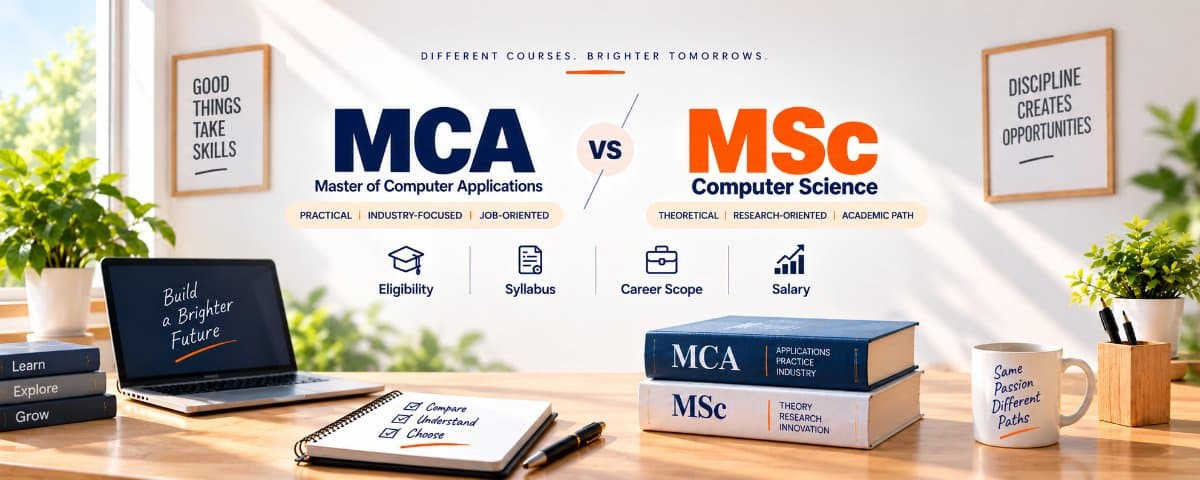
The MCA vs MSc Computer Science question arrives every year in the same shape: a BCA or BSc CS student, final semester, two application forms open in different browser tabs, and a family conversation going in circles. Someone's cousin says MCA has "more value". Someone's senior says MSc is "for people who can't get into MCA". Both statements are wrong, and both are repeated confidently enough to derail good decisions.
Here is the honest version. These are not a better course and a worse course. They are two different bets — one on industry readiness, one on depth and research — and the right answer depends entirely on what you intend to do afterwards. This guide compares them across eligibility, syllabus, fees, placements, salary, government jobs, higher study and long-term ceiling, then tells you plainly which one fits which student.
Quick Comparison
| Parameter | MCA | MSc Computer Science |
|---|---|---|
| Full form | Master of Computer Applications | Master of Science in Computer Science |
| Duration | 2 years | 2 years |
| Eligibility | BCA/BSc CS/IT or any graduate with Mathematics; varies by state | BSc CS/IT or allied science degree, usually with Mathematics |
| Admission | State CET (MAH MCA CET in Maharashtra), NIMCET, university tests | Mostly university merit or entrance; fewer common exams |
| Indicative fees | ₹60,000 – ₹3,00,000 per year | ₹15,000 – ₹1,50,000 per year |
| Course focus | Applied software development and IT systems | Computing theory, research and specialisation |
| Programming intensity | Very high, project-driven | High, but more concept-driven |
| Research orientation | Low to moderate | High — dissertation is central |
| Typical fresher salary | ₹4 – 8 LPA | ₹3.5 – 7 LPA |
| Best for | Industry-bound software careers | Research, teaching, PhD, specialised R&D |
What Is MCA?
MCA is a professional postgraduate degree built to produce industry-ready software professionals. The design intent shows in the syllabus: heavy programming, software engineering process, databases, full-stack development, and a substantial project or industrial training component in the final semesters.
Who it suits. Students who want to build software for a living and want the shortest credible path from where they are to a developer role. It is especially valuable for BCA and BSc graduates who felt their three-year degree left them short of what employers expect.
Core skills you leave with. Practical development across at least two stacks, database design, software engineering discipline, and — at good institutions — exposure to cloud, DevOps and modern frameworks.
Industry relevance. Service companies and mid-tier product firms actively recruit MCA graduates. The degree is well understood by Indian HR systems, which matters more than it should.
What Is MSc Computer Science?
MSc Computer Science is an academic postgraduate degree. It goes deeper into the theory — advanced algorithms, computation, machine learning foundations, distributed systems — and culminates in a dissertation rather than an industrial project.
Who it suits. Students who enjoyed the theoretical side of their bachelor's degree, who are drawn to research or teaching, or who intend to pursue a PhD or a research-oriented MS abroad.
Research opportunities. This is the real differentiator. An MSc dissertation, supervised properly, is a genuine research output — the kind of thing PhD admissions committees and research labs look for. MCA rarely produces that.
Academic focus. MSc is also the standard route into UGC NET, SET and college lectureship, which MCA graduates can pursue but for which MSc is the more conventional qualification.
MCA vs MSc Computer Science — Complete Comparison
| Dimension | MCA | MSc Computer Science |
|---|---|---|
| Curriculum design | Application and project-led | Theory and concept-led |
| Programming hours | Higher | Substantial but lower |
| Mathematics depth | Moderate | Higher |
| Industrial training | Usually compulsory, often a full semester | Optional at many universities |
| Dissertation | Project, industry-oriented | Research dissertation |
| Campus recruitment | Stronger and more organised | Weaker at most universities |
| Industry exposure | High | Moderate |
| Teaching eligibility | Possible with NET | Conventional route |
| PhD pathway | Possible but less direct | Direct and expected |
| Government technical roles | Widely accepted | Widely accepted; better for scientist posts |
| Fees | Higher | Lower, especially at state universities |
| Overall ROI | Strong for industry careers | Strong for research and academia; excellent on cost |
Eligibility Criteria
MCA
- A bachelor's degree of minimum three years from a recognised university.
- Mathematics at Class 12 or graduation level — required in most states including Maharashtra.
- Minimum aggregate typically 50% for open category and 45% for reserved categories.
- A valid entrance score: MAH MCA CET in Maharashtra, NIMCET for NITs, or the university's own test.
MSc Computer Science
- BSc in Computer Science, IT or an allied science discipline; some universities accept BCA.
- Mathematics usually required at graduation level.
- Minimum aggregate typically 50%, varying by university.
- Admission by merit at many universities; entrance tests at others.
Watch this: BCA graduates are sometimes ineligible for MSc CS at universities that require a BSc, and BSc graduates without Mathematics can be blocked from MCA. Check the specific university's clause before you build a plan around either.
Admission Process
MCA in Maharashtra runs through MAH MCA CET followed by a centralised admission process — registration, document verification, merit list, choice filling, allotment and reporting. It is a structured, state-run pipeline with published cut-offs.
MSc Computer Science is decentralised. Most state universities admit on graduation merit through their own portals; some conduct entrance tests; central universities run their own examinations. There is no single common exam, which means you apply to each university separately and track several deadlines.
Practical consequence: MCA admission is more competitive but more transparent. MSc admission is easier to secure but requires more legwork to find and apply to good departments.
Syllabus Comparison
| Area | MCA | MSc Computer Science |
|---|---|---|
| Semester 1 | Programming, Data Structures, DBMS, Computer Organisation, Discrete Maths | Advanced Algorithms, Theory of Computation, Advanced DBMS, Mathematical Foundations |
| Semester 2 | OOP/Java, Operating Systems, Software Engineering, Web Technologies, Networks | Distributed Systems, Advanced Operating Systems, Design & Analysis of Algorithms, Networks |
| Semester 3 | Cloud, Mobile Development, Machine Learning basics, Electives, Mini Project | Machine Learning, Data Science, Cryptography/Security, Electives, Research Methodology |
| Semester 4 | Industrial project / internship (often full semester) | Research dissertation |
Both cover the same fundamental territory. The difference is emphasis: MCA asks "how do we build and ship this?"; MSc asks "why does this work, and can we do better?"
What Two Years Actually Feel Like
Syllabus tables tell you the subjects. They do not tell you how the two years are spent, which is what students actually want to know.
In an MCA, the rhythm is assignment-driven. You are building something almost continuously — lab submissions, mini projects, a database application in one semester, a web application in the next. The final semester is often spent inside a company on industrial training, which means you graduate having already worked to deadlines set by someone other than a professor. Students who like visible progress and dislike open-ended ambiguity tend to thrive here.
In an MSc, the rhythm is reading-driven. There are labs and assignments, but the centre of gravity is understanding why an algorithm has the complexity it has, or why one consistency model is chosen over another. The final year narrows to a dissertation: one problem, months of work, a supervisor who expects you to defend your choices. Students who enjoy going deep on one thing, and can self-direct without weekly deadlines, do well.
Neither rhythm is superior. But they suit genuinely different people, and a student who needs external structure will struggle with an MSc dissertation in a way the marksheet will never explain.
Detailed Syllabus Comparison
| Subject Area | MCA Treatment | MSc CS Treatment |
|---|---|---|
| Programming | Multiple languages, framework-heavy, build-focused | Fewer languages, deeper on paradigms and correctness |
| Data Structures & Algorithms | Applied implementation | Design, analysis and complexity proofs |
| Databases | Design, SQL, application integration | Query optimisation, transactions, distributed data |
| Operating Systems | Concepts plus practical system programming | Advanced OS, concurrency, kernel-level theory |
| Networks | Protocols and practical configuration | Network theory, distributed systems, protocol design |
| Software Engineering | Full lifecycle, methodologies, testing, documentation | Covered, but with less process emphasis |
| Machine Learning | Applied — libraries, deployment, use cases | Mathematical foundations, model theory, research methods |
| Cloud Computing | Practical deployment and services | Architecture, virtualisation and scheduling theory |
| Security | Applied application and network security | Cryptography and formal security models |
| Final year | Industrial project or internship | Research dissertation with a supervisor |
Fees Comparison
| Institution Type | MCA (per year) | MSc CS (per year) |
|---|---|---|
| Government / state university | ₹30,000 – ₹80,000 | ₹10,000 – ₹40,000 |
| Private college (affiliated) | ₹80,000 – ₹1,50,000 | ₹40,000 – ₹90,000 |
| Private / deemed university | ₹1,50,000 – ₹3,00,000 | ₹80,000 – ₹1,50,000 |
| Hostel + mess | ₹70,000 – ₹1,80,000 per year | |
| Indicative 2-year total (day scholar) | ₹1.2L – ₹6L | ₹40,000 – ₹3L |
MSc Computer Science is meaningfully cheaper, and at a good state university the cost difference over two years can approach a year's starting salary. That is a real factor, not a footnote.
Placement Comparison
| Factor | MCA | MSc Computer Science |
|---|---|---|
| Campus recruitment activity | Higher — companies recruit MCA cohorts directly | Lower and more variable by university |
| Typical recruiters | Infosys, TCS, Accenture, Capgemini, Cognizant, Wipro, Tech Mahindra, Persistent, Deloitte | Same pool, plus research labs and analytics firms; often accessed off-campus |
| Industry readiness at graduation | Higher — project and training built in | Depends more on the student's own initiative |
| Product-company access | Good with strong DSA | Good with strong DSA; research profile helps for ML roles |
| Fresher package range | ₹4 – 8 LPA typically | ₹3.5 – 7 LPA typically |
Placement figures vary substantially by university and year. The pattern that holds: MCA gives you a better structured on-ramp; MSc gives you the same destinations if you drive your own job search. If you are the kind of student who will not apply off-campus, MCA's organised placement process is worth real money to you.
Career Opportunities
After MCA
- Software Developer / Full Stack Developer
- Mobile Application Developer
- Cloud Engineer and DevOps Engineer
- Data Engineer
- Cyber Security Analyst
- Systems Analyst and Solutions Architect (with experience)
- Technical Consultant and Project Manager (mid-career)
After MSc Computer Science
- Research Scientist and Research Associate
- Machine Learning Engineer and Data Scientist
- Software Engineer (identical roles to MCA graduates)
- Assistant Professor / Lecturer (with NET/SET)
- PhD Scholar
- Scientist roles at government research organisations
Salary Comparison
| Experience | MCA | MSc Computer Science | Comment |
|---|---|---|---|
| Fresher | ₹4 – 8 LPA | ₹3.5 – 7 LPA | MCA's edge comes from campus access, not the degree itself |
| 2–5 years | ₹8 – 18 LPA | ₹8 – 18 LPA | Gap effectively closes — skill decides |
| 5–10 years | ₹18 – 40 LPA | ₹18 – 45 LPA | MSc + ML/research specialisation can pull ahead |
| Academia | Possible with NET | Standard route; UGC pay scales | Security over peak salary |
| International | Both viable; MSc aligns better with research-track admissions abroad | ||
Ranges are indicative and vary by employer, city and skill. For the wider market picture see our highest-paying IT jobs in India guide.
Higher Education After Each
After MCA: M.Tech (through GATE at some institutions), MBA — a very common and lucrative pivot, MS abroad, PhD (possible but you may need to demonstrate research aptitude), and professional certifications in cloud, security or data.
After MSc CS: PhD in India or abroad, UGC NET/SET for lectureship and JRF, research positions at national labs, MS abroad with a strong dissertation behind you, and an MBA if you later pivot to management.
Government Job Opportunities
| Route | MCA | MSc CS |
|---|---|---|
| UPSC / State PSC (any graduate) | Eligible | Eligible |
| SSC and banking exams | Eligible | Eligible |
| NIC, CDAC technical posts | Commonly eligible | Commonly eligible |
| ISRO / DRDO scientist posts | Sometimes restricted to BE/BTech/MTech | Often eligible for CS/research posts |
| PSU technical recruitment | Varies by notification | Varies by notification |
| Assistant Professor | With NET | Conventional route with NET/SET |
Always read the eligibility clause of the specific notification. Discipline lists change and neither degree is universally accepted for every technical post.
Best Certifications for Either Path
Pick two or three that match your target role rather than collecting badges: AWS or Azure cloud certifications, Google Cloud, Docker and Kubernetes for DevOps, Oracle or PostgreSQL for databases, a serious Python or Java track, TensorFlow for ML, and CEH or CompTIA Security+ for security. A certification backed by a project you can demo is worth several that are not.
Future Scope
Demand through the next decade concentrates in artificial intelligence and generative AI, cloud infrastructure, cyber security, data engineering, and increasingly quantum and edge computing. Both degrees are positioned for this, but differently: MCA graduates typically enter through engineering and delivery roles, MSc graduates more often through modelling, research and specialised technical work.
The uncomfortable truth for both: the degree is becoming a smaller share of your employability every year. What you built, what you can explain, and what you keep learning matter more than the two letters before your name.
Advantages of MCA
- Purpose-built for industry employment.
- Organised campus placement in most colleges.
- Compulsory industrial project or internship.
- Widely recognised by Indian recruiters and HR systems.
- Clear structured admission through a state CET.
- Strong pivot options into MBA and management later.
Advantages of MSc Computer Science
- Substantially lower fees, especially at state universities.
- Genuine research training through the dissertation.
- Standard route to NET, lectureship and PhD.
- Deeper theoretical grounding — an advantage in ML and systems roles.
- Better alignment with research-oriented MS admissions abroad.
- Same industry roles available to those who job-hunt actively.
Limitations of MCA
- Higher fees, sometimes considerably.
- Competitive entrance and centralised admission pressure.
- Lighter theoretical depth than MSc.
- Less natural fit for a PhD or pure research career.
- Quality varies enormously between colleges under the same CET.
Limitations of MSc Computer Science
- Weaker campus placement infrastructure at many universities.
- Less structured industry exposure — you must arrange internships yourself.
- Some recruiters and notifications still default to MCA or BE/BTech.
- Outcomes depend heavily on your specific department's research strength.
Which Course Should You Choose?
| If you are… | Choose | Why |
|---|---|---|
| A BCA student wanting a software job | MCA | Direct continuity, structured placement, industry project |
| A BSc CS student who liked the theory | MSc CS | Depth, low cost, and it keeps research open |
| Aiming at product companies | Either | DSA and projects decide this, not the degree |
| Interested in research or a PhD | MSc CS | Dissertation and academic track are built in |
| Targeting teaching / lectureship | MSc CS | Conventional route to NET/SET and academia |
| Targeting government scientist posts | MSc CS | More often listed as an eligible discipline |
| Planning to study abroad (research track) | MSc CS | Dissertation strengthens the application |
| Planning to start something of your own | MCA | Build-and-ship orientation, faster practical skills |
| On a tight budget | MSc CS | State university fees are a fraction of private MCA |
| Unsure and want maximum job safety | MCA | The organised placement process is genuine insurance |
Expert advice: the college matters more than the course. A good MSc department beats a weak MCA college comfortably, and vice versa. Before you finalise, compare the two specific institutions you can actually get into — faculty, labs, last two years' placement lists — rather than comparing the degrees in the abstract.
Three Students, Three Decisions
Abstract comparisons only go so far. Here is how the decision actually plays out.
The BCA student with a job deadline. Family finances mean he needs to be earning within two years, and there is no appetite for a further degree after that. He has decent programming skills but no network and no idea how to find work off-campus. MCA. The structured placement process is worth real money to a student who will not run his own job search, and the industrial training semester gives him something concrete on a resume.
The BSc CS student who liked theory. She enjoyed algorithms and discrete mathematics more than the web development lab, is considering research eventually, and her family can support two more years but not expensive fees. MSc at a good state university. Low cost, a dissertation that opens PhD and research doors, and no closed doors on industry provided she applies actively in her final year.
The BCA student targeting product companies. He has been doing competitive programming for a year, has a GitHub with real projects, and wants a ₹20 lakh offer rather than a ₹4 lakh one. Either — and it barely matters. His outcome will be decided by DSA practice and interview performance, not the degree. He should pick whichever is cheaper and leaves him more time to prepare, which is usually the MSc.
Notice the pattern. The degree matters most for the student who needs the institution to create opportunities, and least for the student who creates his own.
Common Myths
- "MCA has no value any more." Untrue. It remains one of the most reliably recruited postgraduate qualifications in Indian IT services.
- "MSc Computer Science has no placements." Untrue, but placement support is lighter. Graduates who apply off-campus place perfectly well.
- "MCA is only for BCA students." Untrue. Any graduate with the required Mathematics can apply.
- "Research has no career opportunities in India." Outdated. Corporate R&D, national labs and AI research teams hire actively.
- "MSc is the backup for people who miss MCA." Simply false, and it leads students into an expensive course they did not need.
Frequently Asked Questions
Which has better placements, MCA or MSc Computer Science?
MCA generally has stronger and more organised campus placement. MSc graduates reach the same companies but more often through off-campus applications.
Which offers a higher salary?
MCA typically starts slightly higher (₹4–8 LPA vs ₹3.5–7 LPA). The gap closes within a few years, and specialised MSc graduates in ML or research can overtake.
Can BSc students pursue MCA?
Yes, provided they meet the Mathematics requirement at Class 12 or graduation level and clear the relevant entrance test.
Can BCA students pursue MSc Computer Science?
At some universities yes, at others no — several require a BSc specifically. Check the individual university's eligibility clause.
Which is better for artificial intelligence and machine learning?
MSc has the mathematical and theoretical edge for research-oriented ML roles. For applied ML engineering, either works if you build the skills.
Which is better for data science?
MSc for the statistics and research grounding; MCA for engineering-heavy data roles. Your portfolio matters more than the choice.
Which is better for government jobs?
Both qualify for general graduate-level exams. MSc is more often listed as eligible for scientist and research posts; read each notification.
Which is better for studying abroad?
MSc, if you are targeting research-oriented programmes — the dissertation is a genuine asset. For coursework master's programmes, both are accepted.
Which course is easier?
Neither is easy. MCA is heavier on continuous project work; MSc is heavier on theory and independent research. Choose by temperament, not perceived difficulty.
Which has better return on investment?
MSc at a state university has excellent ROI because fees are low. MCA has strong ROI where the college has genuine placement activity. Compare specific institutions.
Is MCA still relevant in 2026?
Yes. It remains a recognised, actively recruited qualification, particularly across IT services and mid-tier product companies.
Can I do a PhD after MCA?
Yes, though the path is less direct than from MSc. You may need to demonstrate research aptitude through publications or an entrance process.
Can I become a professor after MCA?
Yes, with UGC NET and typically a PhD later, though MSc is the more conventional academic route.
Which should I pick if I am undecided?
If you want a job in two years and value structured placement, choose MCA. If you value depth, low cost and keeping research open, choose MSc. Then compare the actual colleges available to you before finalising.
Conclusion
The MCA vs MSc Computer Science decision is not about prestige. MCA is the industry bet — structured, applied, placement-supported, and more expensive. MSc is the depth bet — cheaper, more theoretical, research-enabling, and more dependent on your own initiative for placement.
Match the bet to your intent. Software career with a clear on-ramp? MCA. Research, teaching, PhD or a specialised technical track on a modest budget? MSc. And whichever you pick, remember that within three years of graduating, nobody in an interview will ask which one you did — they will ask what you have built and what you understand.
Continue your research with our guides on MCA colleges in Pune, BSc Computer Science colleges in Pune, highest-paying IT jobs in India and career options after graduation on CollegePune.
Official sources: UGC, AICTE, NAAC, NIRF, State CET Cell Maharashtra and official university websites.
Disclaimer: fees, eligibility, placement statistics and salary ranges vary by university, city and year, and the figures here are indicative. Verify current details with the institution before applying.
CollegePune Careers Desk
CollegePune Editorial Team
Expert in Pune college admissions, entrance exam guidance, and higher education in Maharashtra. Helping students make informed decisions since 2020.