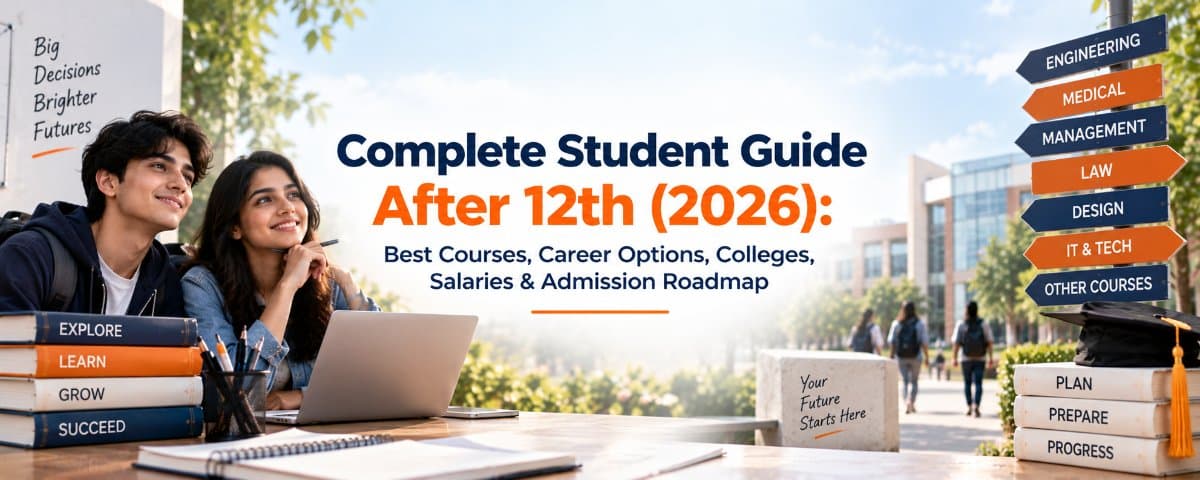
Complete Student Guide After 12th (2026): Best Courses, Career Options, Colleges, Salaries & Admission Roadmap
CollegePune Career Counselling Team
CollegePune Editorial
A few days after the Class 12 results were declared, three students walked into our counselling office together.
A few days after the Class 12 results were declared, three students walked into our counselling office together.
One had scored 94%. One scored 78%. One had barely crossed the passing marks.
Interestingly, none of them asked "which course pays the highest salary?" All three asked the same thing, almost word for word — "What should I do after 12th?"
The answer wasn't the same for any of them.
The topper wanted to talk about consulting and IIMs but hadn't once mentioned what subject actually interested him. The 78-percenter had a genuine curiosity about how apps get built but assumed engineering was out of reach without a higher score. And the third student — the one everyone in the room seemed quietly worried about — turned out to be the sharpest at spotting business opportunities, the kind of person who'd already sold sneakers on Instagram to fund his own phone. Marks told us almost nothing about any of them.
That's the honest starting point here. Every year, lakhs of students search "courses after 12th" hoping for a ranked list that tells them what to do. What they actually need is a framework — something that helps them ask better questions about themselves before they ask questions about courses.
Why Most Students Choose the Wrong Course
I've sat across the table from enough students to notice a pattern. The wrong course rarely gets picked because someone lacks information. It gets picked because someone else's voice was louder than the student's own reasoning.
Peer pressure is the quiet one. A friend group of five decides on engineering, and the sixth person — who was leaning toward design — goes along with it because nobody wants to be the odd one out at eighteen.
Parents, understandably, push toward what feels safe. A stable government job, a recognisable degree, something relatives won't ask uncomfortable questions about. Their intentions are good. Their information is often ten years out of date.
Social media sells a version of success that's mostly editing. A reel about a 22-year-old earning big from data science doesn't show the eighteen months of unglamorous learning before that. Students walk in quoting numbers they saw online that nobody in the room can actually verify.
Salary myths travel faster than facts. "CA is the highest-paying option" or "engineering is oversaturated now" — both get repeated so often they start sounding true, regardless of whether they hold up.
Then there's the one I find most damaging: ignoring skills entirely. A student who freezes during public speaking, forced into a BBA because "business is where the money is," spends three years unhappy in classroom presentations. And following friends rounds it off — the single most common reason a 12th-pass student picks a college, and probably the weakest reason to pick one.
None of this means parents or friends should be ignored. It means their input should come after a student has done some honest thinking about themselves, not before.
The Career Decision Blueprint
When a student can't decide, I don't hand them a list. I draw this instead, and we work through it together, step by step.
Interest → Skills → Career Goal → Course → College → Internships → Career
Interest comes first because it's the only thing that survives a bad semester. Everyone loves their course on day one. What matters is whether the subject still interests you on a rough Tuesday in the second year.
Skills come next — not talent in some inborn sense, but the things you're already reasonably good at or genuinely enjoy improving. A student who loves numbers but hates writing is a poor fit for journalism, no matter how "in demand" content careers seem right now.
Only once interest and skills are somewhat clear does a career goal start to make sense — not a job title necessarily, but a direction. From there, the course picks itself, the college narrows down to ones that actually support that course well, internships turn theory into real experience, and the career follows from all of it.
Most families run this backwards. College brand first, course second, and interest — if it comes up at all — last. That's usually where regret starts showing up around the third year.
Quick Course Finder
Before diving into the full stream-wise breakdown, here's a fast way to orient yourself. Find the row that matches what you're chasing, and start there.
| If You Want... | Consider |
|---|---|
| Highest Salary Potential | Engineering (CS/AI/Data), CA, Medicine, Management (via MBA later), Investment Banking-adjacent (CFA) |
| Government Job Security | B.Sc/B.A. + UPSC/State PSC prep, Nursing (govt hospitals), B.Com + Banking exams, Defence (NDA, CDS) |
| Business & Entrepreneurship | BBA, B.Com, Entrepreneurship-focused BBA programs, direct venture-building alongside any degree |
| Study Abroad Later | B.Sc, BBA, Liberal Arts (BA), Engineering — all portable degrees with strong grad-school pathways |
| Fast Entry Into a Job | Diploma courses, Paramedical courses, Digital Marketing certifications, ITI trades |
| Creative Career | Fashion Design, Animation, Fine Arts, Mass Communication, UI/UX Design |
| Low-Fee, High-Value Degree | B.A./B.Com/B.Sc at government or aided colleges, Nursing at government institutions |
| To Build Something of Your Own | BBA (Entrepreneurship), B.Tech + startup route, any degree paired with a real side project |
One honest note here: this table is a starting point, not a verdict. A student chasing "highest salary" who genuinely hates mathematics is going to struggle through an engineering degree regardless of what the placement brochure promises.
Which Course Fits Your Personality?
This is the section most guides skip entirely, and it's usually the most useful conversation we have in counseling.
If you like structure, rules, and precision — accounting, engineering, law, and pharmacy tend to reward that instinct. If you get restless with rigid formats and prefer persuading, negotiating, or presenting — marketing, business management, mass communication, and entrepreneurship-focused courses fit better.
Students who like solving abstract puzzles quietly, without needing constant social interaction, often do well in computer science, data science, or research-heavy science degrees. Students who feel energised by people — talking, organising, leading — tend to thrive in HR, event management, hospitality, and BBA-style programs with heavy group project components.
There's also a smaller but real group: students who want to build things with their hands, literally or digitally. Architecture, animation, fashion design, and product design suit this instinct far better than a pure theory-heavy degree ever will.
None of these are locked categories. But if a student can't articulate which bucket they lean toward, that's usually the first conversation worth having.
Courses After 12th by Stream
Science Stream
PCB (Physics, Chemistry, Biology): The traditional route toward MBBS, BDS, BAMS, BHMS, Nursing, Pharmacy, Biotechnology, and Paramedical Sciences. NEET remains the gateway for most medical programs — verify current eligibility criteria on the NTA's official website before assuming anything about cutoffs or reservation categories.
PCM (Physics, Chemistry, Mathematics): Opens into Engineering (via JEE Main/Advanced or state CETs), Architecture (via NATA), pure sciences (B.Sc in Physics, Chemistry, Mathematics, Statistics), and increasingly, direct entry into Data Science and Computer Applications programs that prefer a maths background.
PCMB (both Maths and Biology): Keeps both medical and engineering doors open at once — genuinely useful for a student who hasn't decided yet, though it does mean a heavier Class 11-12 workload.
Without Maths: PCB students without Maths can still pursue Biotechnology, Nursing, Pharmacy, Paramedical courses, and several life-science degrees. Maths isn't a wall here — it's a filter for specific engineering and finance-heavy paths.
Without NEET: Biotechnology, B.Sc courses, Nursing (some private institutions), Paramedical diplomas, and Forensic Science don't require a NEET score, though many still expect a science-stream background.
Without JEE: State-level CETs, private engineering colleges with direct/institutional admission, B.Sc in Computer Science, BCA, and various diploma-to-degree engineering pathways don't require a JEE score specifically.
Commerce Stream
B.Com (including specialisations like B.Com Honours, B.Com Banking & Insurance, B.Com Accounting & Finance), BBA, BMS, professional routes like CA, CS, CMA, and finance-adjacent global certifications like CFA and ACCA. Commerce also opens smoothly into Economics, Actuarial Science, and increasingly, Business Analytics programs.
Arts/Humanities Stream
BA (History, Political Science, Psychology, Sociology, English, Economics), BA LLB (integrated law), Journalism & Mass Communication, Fine Arts, Fashion Design, Social Work (BSW), and Hotel Management. Arts is also the most direct runway into UPSC/civil services preparation, since the syllabus overlap with subjects like Political Science, History, and Sociology is considerable.
Micro-insight competitors usually skip: Arts is often treated as the "backup stream," but it's actually the stream with the widest range of postgraduate options — law, civil services, design, media, psychology, and social research all branch out from here more naturally than people assume.Professional Courses After 12th
| Course | Stream Required | Typical Duration | What It Leads To |
|---|---|---|---|
| CA (Chartered Accountancy) | Commerce (any stream can attempt, commerce preferred) | 4–5 years (exam-paced) | Auditing, taxation, financial consulting |
| CS (Company Secretary) | Any stream | 3+ years | Corporate governance, compliance roles |
| CMA (Cost & Management Accountancy) | Commerce preferred | 3–4 years | Cost accounting, financial management |
| ACCA | Commerce preferred | 2–3 years | Global accounting, international finance roles |
| CFA | Any stream (usually post-graduation entry) | Self-paced, multi-level | Investment banking, portfolio management |
| Pilot Training (CPL) | PCM (Physics & Maths mandatory) | 1.5–2 years | Commercial airline pilot |
| Merchant Navy | PCM (most courses) | 1–4 years depending on course | Deck/engine officer roles at sea |
| NDA | PCM for Army/Navy/Air Force technical entries | 3 years (Academy) + training | Defence services commissioned officer |
| Hotel Management | Any stream | 3–4 years | Hospitality, culinary, hotel operations |
| Fashion Design | Any stream | 3–4 years | Design houses, styling, retail brands |
| Animation & VFX | Any stream | 1–4 years (diploma to degree) | Gaming, film VFX, digital content |
| Architecture (B.Arch) | PCM + NATA/JEE Paper 2 | 5 years | Architectural firms, urban planning |
| Pharmacy (B.Pharm) | PCB/PCM | 4 years | Pharmaceutical industry, drug research |
| Nursing (B.Sc Nursing) | PCB | 4 years | Hospitals, healthcare, government nursing posts |
| Paramedical Courses | PCB (mostly) | 1–3 years | Lab technology, radiology, physiotherapy support |
| Data Science | PCM/Commerce with Maths | 3–4 years (degree) or shorter (certification) | Analytics, business intelligence |
| Cyber Security | PCM preferred | 3–4 years (degree) or certification route | Security analyst, ethical hacking roles |
| AI & Machine Learning | PCM preferred | 3–4 years (degree) or certification route | ML engineering, applied AI roles |
| Digital Marketing | Any stream | Certification: months; Degree: 3 years | SEO, performance marketing, brand roles |
Verify current eligibility, exam pattern, and duration details directly with the respective regulatory body (ICAI for CA, ICSI for CS, ICMAI for CMA, DGCA for pilot training, NMC for nursing) before making a final decision — these details are revised periodically.
Highest Paying Courses — and Where ROI Tells a Different Story
Here's a distinction almost no competitor article makes clearly: highest salary and highest ROI are not the same conversation.
A five-year medical degree followed by specialisation can lead to strong long-term earning, but the fee investment is enormous, and the payoff often arrives a decade later. A three-year BBA followed by an MBA can reach comparable management-track salaries faster, at a fraction of the cost, if the student engages seriously with internships along the way.
| Path | Salary Ceiling | Time to First Real Income | ROI Character |
|---|---|---|---|
| Engineering (CS/AI specialisation) + strong internships | High | 3–4 years | Strong — in-demand skills, fast market entry |
| Medicine (MBBS + specialisation) | Very high, long-term | 8–10+ years | Slower ROI, but stable long-term ceiling |
| CA | High | 4–5 years (exam-paced) | Excellent — low course cost relative to earning potential |
| BBA + MBA | High | 5–6 years combined | Good, if internships and networking are taken seriously |
| Data Science / AI (degree or strong certification) | High and rising | 3–4 years, or faster via certification | Very strong right now, given current market demand |
| Diploma + Skilled Trade | Moderate | 1–2 years | Fast, dependable ROI — underrated by most students |
| Pure Arts (BA) + Civil Services prep | Government-scale, if selected | 3–6 years including prep | High if selected, but selection isn't guaranteed |
Exact salary figures shift by city, company, and year, and any number quoted online should be treated as an estimate rather than a promise. What stays consistent is the pattern: courses that combine a real skill with active market demand tend to outperform courses chosen purely for brand name.
Job-Oriented Courses (Fastest Route to Employment)
Not every student wants — or can afford — a four-year runway before earning. For students who want to start working sooner, these routes tend to move faster:
- Diploma courses in Engineering, Hotel Management, or Computer Applications — typically 1–3 years, with lateral entry into degree programs later.
- Paramedical diplomas — lab technology, radiology assistance, and physiotherapy-support courses leading directly into hospital and clinic roles.
- Digital Marketing certifications — one of the fastest-moving job markets right now, with credible providers (Google, HubSpot, Meta) alongside full degree options.
- ITI trades — for students inclined toward technical, hands-on work, with strong absorption into manufacturing and skilled trades.
- BCA — moves faster into the tech job market than a full engineering degree for students specifically interested in software development.
The trade-off is real: faster entry usually means a lower salary ceiling early on. A diploma-holder who keeps learning tends to out-earn a degree-holder who stops learning the day they graduate.
Government Career Options After Each Stream
Parents ask about this more than almost anything else, and for good reason — government roles still carry a stability private-sector jobs don't always match.
After Science: Engineering Services (GATE/ESE), Indian Forest Service, Defence technical entries (NDA, CDS), government hospital postings after MBBS/Nursing/Pharmacy, ISRO and DRDO recruitment for specific degrees.
After Commerce: Banking exams (IBPS, SBI PO/Clerk), SSC CGL, Income Tax and Customs roles, Insurance exams (LIC AAO), and specialised government finance roles for CA/CS-qualified professionals.
After Arts: UPSC Civil Services (IAS/IPS/IFS), State PSC exams, Judicial Services (after Law), Teaching (via B.Ed), and various Group B/C posts through SSC and state-level exams.
Eligibility criteria, age limits, and exam patterns change periodically — verify current details on the official UPSC, SSC, IBPS, or state PSC website.
Future Scope Till 2035 — Where the Real Growth Is Headed
Ten years is a long runway in career terms, and a few directions look genuinely durable rather than trend-driven.
Healthcare demand isn't going anywhere — an aging population and expanding private healthcare infrastructure mean nursing, pharmacy, paramedical, and medical roles are likely to stay in steady demand. Renewable energy and sustainability-linked engineering roles are growing as India's infrastructure push continues. Data, analytics, and AI-adjacent roles are almost certainly going to keep expanding, though what those roles look like will shift as the tools shift. Financial services stay resilient because money management doesn't disappear, even when the tools around it change. And skilled trades, oddly enough, are quietly becoming more valuable, not less, as fewer students choose that path.
The one theme that shows up across almost every durable career: adaptability matters more than the course title on your degree certificate. A rigid skill set — no matter how in-demand today — ages faster than a mindset that keeps updating itself.
AI's Impact on Different Careers
This question comes up in nearly every counselling session now, and it deserves a direct answer rather than a vague one.
Roles built on repetitive, rules-based tasks — basic data entry, simple content drafting, predictable coding tasks — are genuinely being reshaped by AI tools faster than most other categories. That doesn't mean these fields disappear; it means the entry-level version of these jobs looks different than it did five years ago.
Roles built on judgment, relationship-building, physical presence, or deep domain expertise are proving far more resistant. A doctor examining a patient, a lawyer arguing a case, a chef running a kitchen, a therapist reading a room — these depend on human context that current AI tools don't replace, even as they increasingly assist with the administrative layer around these jobs.
For students choosing tech-adjacent courses like Computer Science, Data Science, or AI itself — here's the honest framing: the smartest students in these fields aren't avoiding AI, they're becoming the people who build and manage it. The risk isn't choosing a tech course; it's learning only the parts of it that a tool can now do faster than you.
Study Abroad Opportunities After 12th
Study abroad decisions usually fall into two buckets — going straight after 12th for an undergraduate degree, or completing an undergraduate degree in India and going abroad for a master's.
| Route | What It Looks Like | Best Suited For |
|---|---|---|
| UG abroad right after 12th | Direct application to foreign universities using 12th marks, SAT/ACT, or equivalent | Families with strong financial readiness and a student clear on their direction early |
| UG in India + Master's abroad | Complete B.Sc/BBA/B.Tech/BA in India, then apply for MS/MBA/MA abroad | Most Indian students — lower upfront cost, degree portability |
| Twinning/Dual-degree programs | Part of the degree completed in India, part abroad, through university tie-ups | Students who want international exposure without the full cost of a foreign UG degree |
Popular destinations continue to include the US, UK, Canada, Australia, and Germany, though visa policies, tuition costs, and post-study work rights shift frequently enough that current details should always be checked on the respective country's official education or immigration portal before planning around them. A portable, well-recognised undergraduate degree — Science, Commerce, Engineering, or Liberal Arts — tends to make the "master's abroad" route smoother than a narrowly vocational one.
Entrepreneurship Pathways
Not every student needs to wait for a placement drive. Some are already building something before they've even chosen a college.
A BBA with an Entrepreneurship specialisation, paired with a college that runs an actual incubation cell (not just an annual business-plan competition), gives structured support to a student who already has a venture idea. Engineering students with a product idea increasingly use their college years to build and test an MVP, sometimes with support from a Technology Business Incubator, if the college has one. Commerce and Arts students with a creative or service-based idea often start small during college and scale after graduation, treating the degree as a safety net rather than the main plan.
The honest advice we give in counselling: entrepreneurship isn't a course, it's a decision layered on top of whichever course you pick. A college's "startup culture" branding is worth far less than whether it actually connects students to mentors and seed funding — ask for specifics, not slogans.
Remote Work Career Options
This is genuinely new territory compared to what a counsellor would have said even ten years ago. Digital Marketing, Content Writing, Graphic and UI/UX Design, Software Development, Data Analysis, and Virtual Assistance-style roles are increasingly structured around remote or hybrid work, especially freelance and contract-based engagements. A Commerce or Arts student who builds a genuine skill here — through a certification, a portfolio, or a degree with a practical component — can realistically work with clients well outside their own city.
The catch: remote work rewards demonstrated skill far more than a degree certificate alone. A portfolio or a certification backed by actual client work tends to matter more here than the name of the college on a resume.
Scholarships for Students After 12th
| Scholarship Type | Who It's For |
|---|---|
| National Scholarship Portal (NSP) | Central government scholarships based on category, income, and merit |
| State Government Scholarships | Domicile-based, income and category criteria (varies by state) |
| Institutional Scholarships | Merit-based fee waivers offered directly by many private colleges and universities |
| Minority Scholarships | Community-specific scholarships through central/state schemes |
| Private/Corporate Scholarships | Offered by foundations, trusts, and companies — eligibility varies widely |
At private colleges and universities in particular, institutional scholarships can genuinely change the cost equation for a strong Class 12 scorer. Confirm current eligibility percentages, renewal conditions, and application deadlines directly with the NSP portal or the specific institution — these details change every academic cycle.
Education Loans — What to Actually Check
Most nationalised and private banks offer education loans for recognised courses, typically covering tuition, hostel, and sometimes equipment costs, with the loan usually structured against the student's future earning potential and a co-applicant's (usually a parent's) financial standing.
A few things worth understanding before signing anything: interest rates and moratorium periods (the gap before repayment starts, usually covering the course duration plus a short buffer) vary significantly between banks and loan schemes. Government-backed schemes sometimes offer subsidised interest for economically weaker sections — worth checking specifically rather than assuming it doesn't apply. And collateral requirements typically kick in above a certain loan amount, which varies by lender.
Current interest rates, loan limits, and eligibility should be confirmed directly with the bank or through the Vidya Lakshmi portal, since these figures are revised periodically and vary meaningfully between public and private lenders.
College Selection Guide
Once the course is settled, the college decision comes down to a shorter checklist than most students expect.
Check whether the college's accreditation (NAAC, NIRF ranking, or relevant regulatory body approval — AICTE for technical courses, NMC for medical, Bar Council for law) is current, not from several cycles ago. Look at the actual internship and placement process, not just the headline numbers — ask how many companies visited last year, not just the highest package quoted. Visit if possible, or at minimum talk to a current student directly; a campus that looks impressive in photographs can feel very different once you're attending classes there every morning for three or four years. And compare the fee structure against what the degree typically opens into — a premium fee only makes sense if the student is going to genuinely use the network, internships, and brand that come with it.
A pattern worth naming directly: the difference between a good college and the right college is almost always the student's career goal, not the college's ranking. A top-ranked engineering college is the wrong choice for a student who actually wants to study design.Admission Timeline After 12th
| Period | What Typically Happens |
|---|---|
| March–May | Entrance exams for professional/private courses (JEE, NEET, CUET, private university CETs) |
| May–June | Board results declared; state and central counselling processes begin |
| June–July | Merit lists, seat allotment, document verification for most government/aided colleges |
| July–August | Admission confirmation, fee payment; private colleges often run parallel or slightly earlier cycles |
| August onward | Academic sessions begin; competitive exam prep groups (CA, CAT, UPSC) often start informally in year one |
Private institutions and entrance-based courses tend to move faster than state merit-list processes — if a specific entrance exam is part of your plan, those application windows often open well before board results are even declared.
Common Mistakes Students Make After 12th
The regrets that come up most often, across streams and scoring ranges: choosing a course purely because it's trending on social media, without checking whether the day-to-day work matches personal interest; assuming a high fee automatically guarantees better outcomes, when outcomes depend far more on active engagement; picking a college before confirming it teaches the intended specialisation well; ignoring smaller, well-regarded colleges in favour of a "bigger name" that doesn't fit the course goal; delaying entrance exam prep because boards felt like the only priority; skipping scholarship and loan research until deadlines have passed; and assuming one wrong-seeming choice at 18 is permanent — most career paths have more course-correction room than students assume at this age.
30-Day Career Planning Roadmap
Week 1 — Self-assessment. Sit down and honestly map your interests and skills against the Career Decision Blueprint. Talk to people already working in two or three fields you're curious about, not just people your own age.
Week 2 — Research and shortlist. Narrow down to 2–3 course directions. Research entrance exam requirements, application windows, and realistic eligibility for each. Build a shortlist of 6–8 colleges across a range of fee brackets.
Week 3 — Applications and documentation. Register for relevant entrance exams if applicable. Get documents (marksheets, ID proof, category/income certificates) organised early — this step gets rushed more than any other. Check scholarship eligibility on NSP and relevant state portals.
Week 4 — Decisions and confirmation. Attend interviews or counselling sessions where required. Compare offers against your original goal, not just against each other. Confirm admission and complete fee payment within deadlines, keeping loan paperwork ready if needed.
This roadmap moves fast on purpose — the students who plan reactively, after results are already out, are consistently the ones scrambling in July.
Frequently Asked Questions
What are the best courses after 12th? It depends on stream, interest, and goal — there's no single "best" course. Engineering, Medicine, Commerce professional courses (CA/CS/CMA), and BBA/B.Com remain the most common paths, but "best" should be measured against personal fit, not popularity.
Which course has the highest salary after 12th? Engineering (especially CS/AI), CA, and Medicine tend to lead on long-term earning potential, though figures vary by company, city, and performance — verify current data through official placement reports rather than aggregator estimates.
What are the best courses after 12th science? Engineering, Medicine (MBBS/BDS/BAMS/BHMS), B.Sc in core sciences, Architecture, Pharmacy, Nursing, and increasingly Data Science and AI-focused programs.
What are the best courses after 12th commerce? B.Com, BBA, CA, CS, CMA, ACCA, CFA, and Economics are the strongest common options.
What are the best courses after 12th arts? BA (various specialisations), BA LLB, Journalism & Mass Communication, Fine Arts, Fashion Design, Social Work, and Hotel Management, along with UPSC/civil services preparation.
Can I do engineering without maths in 12th? Generally no for core engineering — most entrance exams require Physics, Chemistry, and Mathematics. Some lateral-entry routes exist; confirm eligibility with the specific institution.
Can I become a doctor without NEET? For MBBS/BDS in India, NEET is currently mandatory. Some allied health courses don't require it — verify current requirements on the NMC's official website.
What are job-oriented courses after 12th? Diploma courses, Paramedical courses, Digital Marketing certifications, BCA, and ITI trades move fastest into employment compared to longer degree programs.
What are the best government courses after 12th? There's no single "government course" — degrees in Science, Commerce, and Arts each open into different government exam pathways (UPSC, SSC, Banking, Defence, State PSC), and eligibility depends on the specific exam.
Are diploma courses better than degree courses? Neither is universally better. Diplomas offer faster job entry and lower cost; degrees typically offer a higher long-term ceiling and more flexibility for further study.
Is BBA a good option after 12th? Yes, for students genuinely interested in business or entrepreneurship — but it works best paired with real internships and, often, an MBA later.
Should I choose a course based on salary or interest? Interest sustains effort over three to four years; salary alone rarely does. The strongest outcomes come from genuine overlap between the two.
What if I don't know what I want to do after 12th? More common than it feels — start with the Career Decision Blueprint, talk to people in a few different fields, and consider a broad-based degree (B.Sc, B.Com, or BA) that keeps multiple doors open.
Can I study abroad right after 12th? Yes, several countries accept direct UG applications, though most Indian students complete a degree here first and go abroad for a master's, largely due to cost.
How important are internships during a degree? Very. Students who complete two or three real internships consistently report stronger placement outcomes than those who wait until the final semester.
Are entrance exams compulsory for all courses after 12th? No — many programs (B.A., B.Com, several B.Sc courses) admit through merit lists, especially at government and aided colleges. Entrance exams are typically required for Engineering, Medicine, Law, and private universities.
What is the biggest mistake students make while choosing a course? Picking a course before honestly assessing personal interest and skill fit — usually driven by peer pressure, parental preference, or a trending salary figure rather than genuine self-assessment.
Career Counsellor's Final Advice
Back to those three students from the beginning — the 94%, the 78%, and the one who barely scraped through.
We didn't start with a course list that day either. We started with a simple question for each of them: what do you actually enjoy doing when nobody's grading you for it? The topper admitted, almost sheepishly, that he liked reading about business strategy far more than his physics textbook. The 78-percenter lit up the moment we mentioned software projects that didn't require a perfect JEE score to access. And the third student — the one everyone assumed needed the most "convincing" — turned out to already understand consumer behaviour better than most business graduates we've met.
None of them left with the same course. All three left with a direction that actually made sense for them.
That's really the whole point of this guide, and probably the one thing worth remembering above everything else in it: your Class 12 percentage tells colleges what you're eligible for. It doesn't tell you who you are or what you're capable of building. Start with honest self-assessment, let that shape the course, let the course shape the college, and treat every number in between — fees, salaries, rankings — as something to verify, not something to assume.
And check everything before you act on it. Course eligibility, entrance exam patterns, fee structures, and scholarship criteria change nearly every year. This guide gives you the thinking behind the decision. The official exam authority, the college's admission office, and government portals like NSP, UGC, and AICTE remain the final word on the specifics.
Explore Next on CollegePune
CollegePune Career Counselling Team
CollegePune Editorial Team
Expert in Pune college admissions, entrance exam guidance, and higher education in Maharashtra. Helping students make informed decisions since 2020.