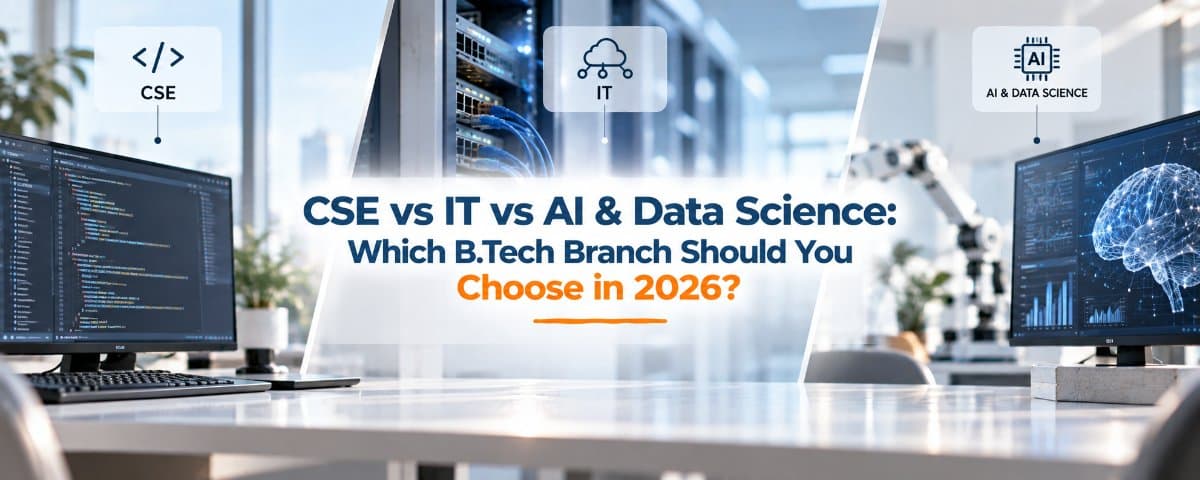
CSE vs IT vs AI & Data Science: Which B.Tech Branch Should You Choose in 2026?
CollegePune Academics Desk
CollegePune Editorial
A clear-eyed comparison of Computer Science, Information Technology and AI & Data Science engineering branches — syllabus differences, job roles, salary reality, cutoff gaps, and who should pick which.
Ask ten engineering aspirants what the difference is between Computer Science and Information Technology and you will get ten answers, most of them wrong. Add AI & Data Science — a branch that barely existed a decade ago and now appears on almost every private college's brochure — and the confusion multiplies. This guide sorts out what actually separates these three branches, what does not, and how to choose without regretting it in third year.
Quick answer: Computer Science is the broadest and safest choice with the deepest fundamentals. Information Technology overlaps with CSE by roughly 70–80% and places almost identically in most colleges. AI & Data Science is a specialised CSE variant that pays off if you genuinely enjoy mathematics and statistics, and is a poor choice if you picked it because it sounded modern.What Each Branch Actually Teaches
Computer Science and Engineering (CSE)
CSE is built on fundamentals: data structures and algorithms, operating systems, computer networks, database management systems, theory of computation, compiler design, computer architecture and software engineering. The emphasis is on how computing works from the machine upward. Electives typically add machine learning, distributed systems, cloud computing and security in the later years.
The value of this foundation is that it does not expire. The specific frameworks a student learns in second year will be obsolete by the time they are promoted; the algorithmic reasoning will not.
Information Technology (IT)
IT shares the majority of its syllabus with CSE — the same data structures, the same DBMS, the same networks. The difference is one of emphasis: IT leans slightly further toward applied systems, enterprise software, information security, web and mobile technologies, and IT infrastructure, and slightly away from theoretical computer science topics like automata theory and compiler design.
In most Indian colleges, an IT graduate and a CSE graduate sit the same placement tests, receive the same offers, and do the same jobs. The branch names diverge more than the careers do.
Artificial Intelligence and Data Science (AI & DS)
AI & DS is a CSE core with the theory subjects trimmed and a heavier mathematical and statistical stack added: linear algebra, probability and statistics, machine learning, deep learning, natural language processing, computer vision, big data systems and data visualisation.
The important thing to understand is that this branch is mathematics-heavy in a way CSE is not. Students who chose engineering partly to escape mathematics find AI & DS considerably harder than they expected.
Syllabus Overlap: The Honest Numbers
| Subject Area | CSE | IT | AI & DS |
|---|---|---|---|
| Data Structures & Algorithms | Core | Core | Core |
| DBMS | Core | Core | Core |
| Operating Systems | Core | Core | Core |
| Computer Networks | Core | Core, deeper | Reduced |
| Theory of Computation | Core | Often elective | Usually dropped |
| Compiler Design | Core | Often elective | Usually dropped |
| Machine Learning | Elective | Elective | Core, multiple courses |
| Statistics & Probability | One course | One course | Multiple, heavy |
| Information Security | Elective | Core | Elective |
| Approx. overlap with CSE | — | 70–80% | 60–70% |
Career Outcomes: Where Graduates Actually End Up
This is where a lot of marketing collapses. In practice:
- CSE graduates go into software development, backend and full-stack engineering, systems, cloud infrastructure, product companies, and increasingly ML roles via electives and self-study.
- IT graduates go into software development, enterprise applications, cloud and DevOps, cybersecurity, and IT consulting. The overlap with CSE destinations is very large.
- AI & DS graduates go into data analysis, data engineering, machine learning engineering, and — the part nobody mentions — ordinary software development, because entry-level pure-ML roles are far fewer than the number of AI & DS graduates being produced.
That last point deserves emphasis. Colleges have expanded AI & DS intake much faster than the market has expanded genuine fresher ML roles. Most AI & DS graduates will start in a general software or data role. That is fine — but choose the branch because you want the mathematics, not because you expect a machine-learning job to be waiting.
Salary Reality
Entry-level compensation is determined far more by the college, the company tier and the candidate's demonstrated skill than by the branch name. Across most Indian campuses:
- Service-company offers to CSE, IT and AI & DS freshers are typically identical, because the same recruitment test is used for all three.
- Product-company offers depend almost entirely on interview performance in data structures and algorithms — a subject all three branches teach.
- Specialist data science roles that pay a genuine premium usually require either a master's degree or two to three years of demonstrated work, not a fresher's branch label.
The practical conclusion: do not pay a higher fee or accept a worse college to get a specific one of these three branch names. The delta is not there.
Cutoff Differences and How to Exploit Them
In most Maharashtra colleges the cutoff ordering is Computer Science highest, then AI & DS or Computer Engineering variants, then IT, then Electronics. The gap between CSE and IT at the same college is often two to four percentile points.
This creates a genuinely useful strategy. A student whose percentile falls just short of CSE at a strong college is usually better off taking IT at that same strong college than CSE at a considerably weaker one. The syllabus overlap is 70–80%, the recruiters are the same, and the peer group — which matters enormously — is the better college's.
The reverse trade is the mistake: dropping two tiers of college quality to keep the letters "CSE" on the degree.
Newer Variants: CSE (AI), CSE (Data Science), CSE (Cyber Security)
Many colleges now offer specialisation-tagged versions of CSE. Before choosing one, check three things:
- Is the branch NBA accredited? Newly launched specialisations often are not, which can matter for certain government jobs and higher-study applications.
- Who teaches it? If the same faculty teach the specialisation as teach general CSE, the specialisation is mostly a naming exercise.
- Is placement data separated? New branches with no graduating batch have no placement record. Ask directly rather than accepting college-wide numbers.
Who Should Choose What
- Choose CSE if you want maximum optionality, are unsure of your eventual specialisation, or plan to pursue higher studies. It is the least regrettable choice.
- Choose IT if it gets you into a materially better college than CSE would, or if you are drawn to security, networks and enterprise systems.
- Choose AI & DS if you actively enjoyed mathematics in Class 11 and 12, are comfortable with statistics, and want the specialisation deliberately — not because it appeared at the top of a brochure.
- Avoid all three if you have no interest in programming. Electronics, Mechanical, Civil and Electrical have genuine, well-paid career paths, and a disengaged CSE graduate does far worse than an engaged core-branch one.
What Each Branch Looks Like Year by Year
Knowing the shape of the four years helps more than a subject list, because the difficulty is not evenly distributed.
First year is identical across all three branches at almost every Indian college — engineering mathematics, physics, chemistry, basic electrical and mechanical engineering, and an introductory programming course. Nothing branch-specific happens. Students who chose AI & DS expecting to start machine learning immediately are usually disappointed.
Second year is where the branches separate and where the workload spikes. CSE and IT students take data structures, discrete mathematics, object-oriented programming, computer organisation and database systems. AI & DS students take the same data structures course but substitute heavier statistics and linear algebra. This is the year that determines your placement outcome, because data structures and algorithms is the subject every technical interview tests.
Third year brings the specialisation subjects — operating systems, computer networks, software engineering, and the first genuine electives. It is also internship season, and the year in which the students who have been building projects pull decisively ahead of those who have not.
Fourth year is dominated by the final-year project, campus placements and electives. By this point your branch has stopped mattering; your resume has taken over.
Skills That Matter More Than Your Branch
A blunt observation from placement data across Indian campuses: recruiters filter on a handful of things, and branch name is rarely one of them.
- Data structures and algorithms. The universal filter. Every product company and most service companies test it. All three branches teach it; only some students practise it.
- One language, properly. Depth in a single language beats surface familiarity with five. Most Indian campus recruitment accepts C++, Java or Python.
- Real projects. Not tutorial clones — something with a genuine problem statement, deployed and usable. Two substantial projects outperform ten trivial ones.
- Version control and basic engineering practice. Git, testing, code review habits. Colleges rarely teach these; employers assume them.
- Communication. The ability to explain a technical decision clearly separates candidates in interviews far more than most students expect.
A student in IT at an average college who has all five of these will out-place a CSE student at a better college who has none. This is not motivational framing — it is what placement outcomes consistently show.
The Case for Not Choosing Any of Them
Roughly two-thirds of engineering aspirants list CSE, IT or a computing variant as their first preference. That concentration has consequences: more competition for the same seats, larger batch sizes, and more graduates chasing the same roles.
Meanwhile Electronics and Telecommunication, Mechanical, Electrical and Instrumentation branches see smaller applicant pools and, at good colleges, perfectly respectable outcomes. Electronics graduates enter embedded systems, VLSI and semiconductor roles — a sector receiving substantial policy support in India. Mechanical and Electrical graduates enter automotive, energy and manufacturing, all of which have long-term demand in Pune's specific industrial ecosystem.
And crucially, a core-branch student who learns programming independently can compete for software roles anyway. The reverse — a CSE student competing for core mechanical roles — is not really available. Optionality runs one way, and it favours students who are honest about what genuinely interests them.
Frequently Asked Questions
Is IT easier than CSE?
Marginally, in that IT usually carries fewer heavy theory subjects like compiler design and automata. The difficulty difference is small and does not affect employability.
Does AI & Data Science have better placements than CSE?
Generally no. In most colleges, CSE places at least as well, because recruiters hire across all computing branches with the same test. AI & DS is worth choosing for the curriculum, not for a placement premium.
Can a CSE student get a data science job?
Yes, routinely. A CSE graduate with machine-learning electives, a few real projects and solid statistics can compete for the same data roles. The branch label is not a gate.
Should I take IT at a top college or CSE at an average one?
IT at the better college, in almost every case. Peer group, faculty and recruiter access matter more than the two-word branch name on your degree.
Which branch is best for higher studies abroad?
CSE, marginally, because its fundamentals map most cleanly onto graduate coursework. IT and AI & DS graduates are admitted to the same programmes regularly, so this should not be a deciding factor.
A Three-Question Test Before You Fill the Option Form
If you are still undecided when the option form opens, answer these honestly rather than asking one more person for an opinion.
Do you enjoy building things with code, or do you enjoy the idea of a software salary? Both are common; only one survives four years of coursework and a career. If it is the second, seriously consider whether a core branch with a clearer industrial pathway suits you better.
How did you feel about mathematics in Class 11 and 12? If the answer is anything short of genuine comfort, AI & Data Science will be harder than you expect. Its statistical core is not optional and does not get easier.
Would you rather be in the top third of a slightly less prestigious branch, or the bottom third of a more competitive one? Placement processes, internal ranking and confidence all favour the first. Students in the top third of any computing branch at a decent college have excellent outcomes; students struggling at the bottom of a marquee branch frequently do worse than the branch name suggests.
Your answers should point clearly at one option. If they point at core engineering rather than any of these three, that is a legitimate and often better result — not a failure of the exercise.
Final Word
The branch you choose matters less than what you do inside it. A student who builds three real projects, contributes to open source and practises algorithms consistently will out-earn a passive student from a "better" branch every time. Choose the branch you will actually engage with — and then engage with it.
Compare branch-wise cutoffs and seat matrices for every Pune college on our engineering colleges page, or ask our counselling team to map your percentile to realistic branch options.
CollegePune Academics Desk
CollegePune Editorial Team
Expert in Pune college admissions, entrance exam guidance, and higher education in Maharashtra. Helping students make informed decisions since 2020.