Student Life in Pune 2026: Areas, Hostels, PGs, Food, Transport and What Nobody Tells You
CollegePune Student Desk
CollegePune Editorial
An honest guide to living in Pune as a student — the best areas by college, hostel vs PG vs flat, food and transport, safety, weather, things to do, and the practical advice first-year outstation students wish they had.

Pune has been a student city for longer than most Indian cities have been cities. Savitribai Phule Pune University alone anchors hundreds of affiliated colleges, and the student population across the district runs into the lakhs. That density shapes everything — the food, the rents, the transport, the fact that you can find a tiffin service at eleven at night. This guide covers what actually matters when you move here.
Quick answer: Live close to your college — Pune traffic makes distance expensive in time and money. Take the hostel in first year if you get it. Deccan, Shivajinagar and Karve Nagar are the classic student belts; Kothrud, Katraj, Pimpri-Chinchwad and Viman Nagar serve their nearby colleges. Budget ₹13,000–₹25,000 a month depending on lifestyle.The Student Areas of Pune
Deccan Gymkhana and Fergusson College Road
The historic centre of student Pune. Bookshops, cheap eateries, cafés that tolerate a four-hour occupancy over one coffee, and a culture that has existed for generations. Rents are higher than the outskirts but transport costs drop to almost nothing because everything is walkable. Best for students at Fergusson, COEP, SPPU departments and BMCC.
Shivajinagar
Central, extremely well connected by bus and metro, and adjacent to COEP and AISSMS. It is a commercial area rather than a purely residential one, which means noise, but also means everything you need is within a few minutes.
Kothrud
A large, well-organised residential area with a substantial student population, good food options and reliable transport. Serves MIT-WPU, Cummins and colleges along Karve Road. Rents sit in the middle of the range.
Karve Nagar and Warje
Slightly cheaper than Kothrud with a strong student rental market. Good access to the Karve Road college corridor and reasonable connectivity.
Dhankawadi, Katraj and Ambegaon
Among the most affordable student areas in the city, serving PICT, Bharati Vidyapeeth and the colleges along Satara Road. A dense mess and tiffin ecosystem has grown around the student population here.
Pimpri-Chinchwad, Akurdi and Nigdi
Effectively a separate city within the Pune metropolitan region, with its own commercial centres and a large industrial base. Serves PCCOE, D. Y. Patil Akurdi and the surrounding institutions. Rents are lower than central Pune and the area is well connected by metro and rail.
Viman Nagar, Kharadi and Magarpatta
East Pune, oriented around the IT corridor. More expensive, more modern, and the practical choice for students doing internships at companies in that belt.
Hinjewadi, Wakad and Baner
West Pune's IT corridor. Popular with final-year students and interns for the same reason — proximity to employers. Traffic on the Hinjewadi corridor is genuinely difficult during peak hours, which is worth factoring into any accommodation decision.
Hostel, PG or Flat?
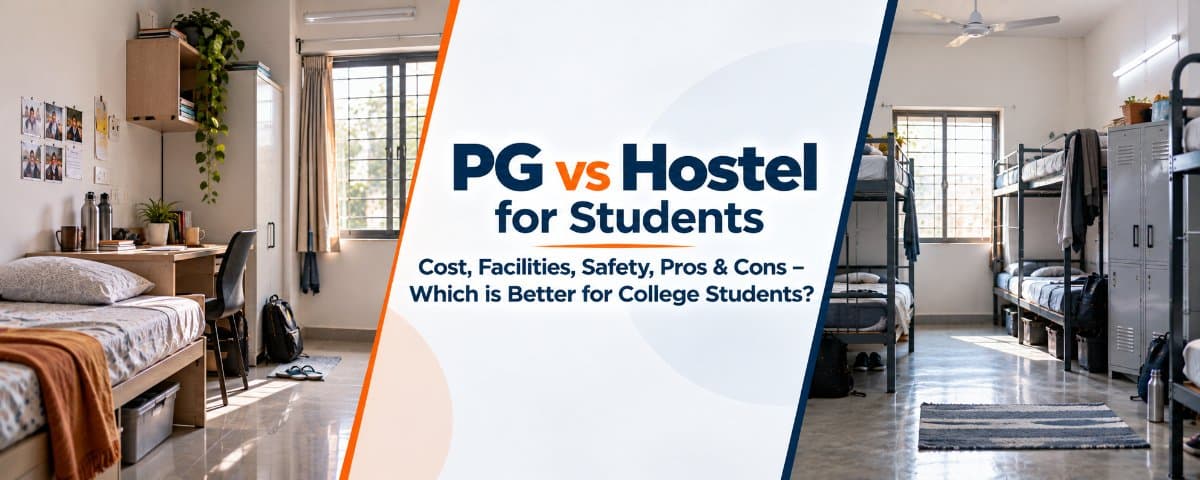
| Factor | College Hostel | PG | Shared Flat |
|---|---|---|---|
| Monthly cost | ₹6K–₹14K | ₹8K–₹18K | ₹7K–₹16K per head |
| Food | Mess included | Often included | Cook or order |
| Freedom | Lowest — curfews, rules | Moderate | Highest |
| Upfront cost | Low | 1–2 months deposit | 2–3 months deposit + setup |
| Social life | Best — built-in cohort | Variable | Depends on flatmates |
| Admin burden | None | Low | High — bills, repairs, cooking |
| Best for | First year | Second year onward | Third year onward |
The pattern that works for most outstation students: hostel in first year, PG or flat afterwards. The first year is when you know nobody and know nothing about the city — the hostel solves both problems at the lowest cost.
Food
Pune is a genuinely inexpensive food city if you know how it works. The main options:
- Tiffin and mess services — ₹3,000–₹4,500 a month for two meals, delivered daily. This is how a large share of Pune's student population eats, and the quality at established services is good.
- College canteens — cheapest lunch option, ₹40–₹100 per meal.
- Student-belt eateries — the areas around Deccan, FC Road, Katraj and SPPU have long-established places serving full meals at ₹80–₹150.
- Cooking — cheapest of all if you have a flat and will actually do it. Budget ₹3,500–₹5,000 a month for groceries when sharing.
- Delivery apps — convenient and the fastest way to destroy a student budget. Treat as occasional.
Pune's local food culture is worth engaging with rather than eating only at chains — misal, vada pav, bhakri thalis and the city's Irani café tradition are all cheap and part of living here properly.
Transport
- PMPML buses — extensive network, monthly student passes at ₹500–₹1,200. Slow but very cheap.
- Pune Metro — clean, fast and reliable on the corridors it covers, with passes available. Increasingly the best option where the route matches your commute.
- Two-wheeler — the default for Pune students who can afford it. Transforms mobility. Wear a helmet, keep documents current, and be realistic about the traffic.
- Bicycle — practical in many areas and free to run.
- Auto and app rides — fine occasionally, ruinous daily.
The single strongest piece of advice about transport in Pune is to avoid needing much of it. Living within fifteen minutes of your college is worth more than any transport optimisation.
Weather and What to Pack
Pune's climate is one of the better reasons to study here. Three seasons, none of them extreme:
- Summer (March–May): Hot in the afternoon but with a genuine drop in the evening thanks to the elevation. Considerably more bearable than most of the Deccan.
- Monsoon (June–September): Heavy and sustained. A good raincoat matters more than an umbrella if you use a two-wheeler. Waterproof your bag — laptops have been lost to a single bad commute.
- Winter (November–February): Pleasant, dry, and genuinely cool in the mornings. One warm layer is enough.
Practical packing: a raincoat, a waterproof bag cover, one warm layer, comfortable footwear that survives monsoon, and a power backup for the occasional outage.
Safety and Practical Setup
- Visit the area at night before signing. Lighting and foot traffic tell you more than any listing.
- Get a rent agreement in writing, with the deposit amount, notice period and what is included clearly stated. Verbal PG arrangements are the source of most deposit disputes.
- Register with a local doctor or clinic in your first month rather than searching for one during a fever.
- Keep a copy of key documents — Aadhaar, college ID, medical information, emergency contacts — both physically and in cloud storage.
- Open a local bank account with Aadhaar linkage; you will need it for scholarships and stipends.
- Share your location with family or a friend when travelling late.
Things Worth Doing
Four years is long enough to have a life, and students who treat the city as a dormitory attached to a college regret it.
- Trekking. Pune is surrounded by Sahyadri forts — Sinhagad, Rajgad, Torna, Lohagad — most reachable in a morning and costing almost nothing.
- College festivals. Pune's technical and cultural festival circuit is among the most active in India, and participating is a better networking route than any career fair.
- The music and theatre scene. Long-established and genuinely accessible on a student budget.
- Technical communities and meetups. Pune's IT density supports active developer, design and startup communities, most of which welcome students free of charge.
- Sports. Most colleges have facilities, and the city has affordable public options.
- Volunteering. A large NGO ecosystem, and a genuinely useful thing to have done.
Advice From Students Who Have Done It
- The first month is the hardest and it does not last. Almost every outstation student finds the first few weeks isolating, and almost every one of them settles by the second month.
- Say yes to things in the first semester. Clubs, festivals, project teams. The social structure of your four years forms early.
- Learn basic Marathi. Not fluency — greetings, directions, numbers, and courtesy. It changes how the city treats you.
- Start internships and projects in second year. Not final year. The students who begin early are the ones with options later.
- Do not live with people you cannot tolerate to save ₹2,000. Flatmate conflict has ruined more academic years than difficult syllabi.
- Track your money for one month. Most students dramatically underestimate what they spend on food delivery and rides.
- Call home more than you plan to. Straightforward advice, consistently given.
Finding a PG or Flat: A Practical Method
- Search in May and June if you want choice. Availability tightens sharply once the academic year starts and prices firm up with it.
- Use multiple channels. Local broker boards near the college, online rental platforms, college notice boards, and senior students. Seniors leaving the city are the single best source — they know which places are good and often hand over deposits directly.
- Visit in person. Photographs are systematically misleading. Check water pressure, power backup, ventilation and how the room feels at the hour you will actually be there.
- Ask what is included. Electricity, water, Wi-Fi, laundry and food are variously included or extra. A cheap-sounding rent with everything billed separately can cost more than a higher all-inclusive one.
- Check the commute at peak hour, not on a Sunday afternoon. Pune traffic between eight and ten in the morning is a different city.
- Get everything in writing — rent, deposit, notice period, inclusions and the condition of the room at handover. Photograph any existing damage on the day you move in.
Budgeting Your First Three Months
The first quarter is disproportionately expensive and catches almost every outstation student out.
- Month one: Security deposit (two to three months' rent), first month's rent, bedding and room setup, kitchen basics if in a flat, and travel. Frequently ₹40,000–₹80,000.
- Month two: Normalises to regular rent and food, plus textbooks, stationery and any lab or equipment purchases the course requires.
- Month three: Roughly steady state, though the first semester examination fees and any club or festival participation costs land here.
Carry a buffer of at least one extra month's expenses beyond what you have planned. The specific thing that goes wrong varies; that something goes wrong does not.
Adjusting as an Outstation Student
Some things are worth knowing before you arrive rather than discovering them.
Language. Pune functions comfortably in Marathi, Hindi and English, and no student is excluded by language. Learning basic Marathi is a courtesy that is noticed and reciprocated, particularly with shopkeepers, auto drivers and landlords.
Food adjustment. If you are used to a very different regional cuisine, the first few weeks of mess food can be difficult. Pune has enough regional restaurants and tiffin services catering to specific cuisines that this is solvable — ask seniors from your region.
Homesickness. Almost universal in the first month and almost universally resolved by the second. The students who struggle longest are the ones who go home every weekend in the first semester and never build a local circle.
The academic pace. Professional courses in Pune move faster than most school environments prepare students for. The gap between school and first-year engineering or medicine catches out even strong students; assume you will need to work harder than you did in Class 12, not less.
Frequently Asked Questions
Is Pune safe for students?
Pune is generally regarded as one of the safer large Indian cities for students, with a long-established student population and reasonable public infrastructure. Standard urban precautions apply — choose well-lit areas, be careful travelling late, and verify accommodation in person.
Which is the best area to live in Pune as a student?
The one nearest your college. Beyond that, Deccan and Shivajinagar for central colleges, Kothrud and Karve Nagar for the Karve Road corridor, Katraj and Dhankawadi for affordability, and Pimpri-Chinchwad for colleges in that belt.
How much does a PG cost in Pune?
Roughly ₹8,000–₹18,000 per month depending on area, room sharing and whether food is included. Central and eastern areas cost more.
Do I need a two-wheeler in Pune?
Not if you live near your college. It becomes genuinely useful if you are commuting across the city or doing internships in the IT corridors.
Is it easy to find accommodation near colleges?
Yes — Pune has a mature student rental market. Availability tightens sharply in June and July when the academic year starts, so search early if you are not taking a hostel.
Final Word
Pune works for students because it was built around them. The food is cheap, the transport is workable, the climate is mild, the hills are an hour away, and there are enough people your age doing the same thing that you will not be lonely for long. Choose your area near your college, take the hostel in first year, and spend the money you save on doing things rather than commuting.
Find colleges by area, with hostel details and fees, on our colleges directory, or ask our counselling team about hostel availability at the colleges on your list.
CollegePune Student Desk
CollegePune Editorial Team
Expert in Pune college admissions, entrance exam guidance, and higher education in Maharashtra. Helping students make informed decisions since 2020.